Spotted Success Training & Behavior Modification
  • HOME
  • ABOUT
  • SERVICES OFFERED
  • GET IN TOUCH
  • RAVE REVIEWS

WEEK OF ENRICHMENT DAY TWO: FOOD SCATTERS & SNUFFLE MATS

5/19/2020

4 Comments

 
Picture

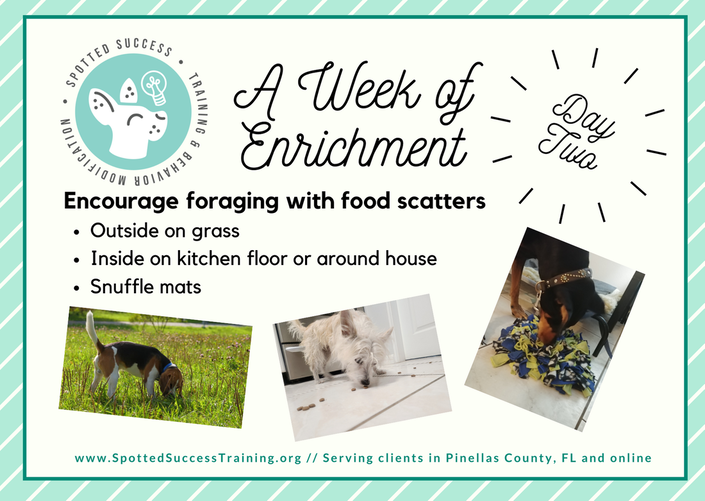
Food Scatters

Treat or kibble scatters are my favorite "lazy" enrichment activity. This enrichment activity involves just what it sounds like - I literally take a handful of small treats or kibble and toss/ scatter it all over an area, then let the dog(s) get busy foraging and searching for the pieces.
 
You might do this across the linoleum floor in your kitchen, in various rooms of the house (forming a "trail of treasure" for your dog to seek out and find), or (my personal favorite) across the grass of the backyard.
 
I jokingly call this "lazy" enrichment, but in actuality it provides a fulfilling and time consuming activity for the dog. It is a technique commonly called "scatter feeding" in the animal training world, but again this practice is not always as common in the pet dog world; I am arguing that it really should be!
 
If you spend time around dog trainers, you may hear the phrase "Ditch the Dish!" used when talking about using food to give your dog more enrichment opportunities in day to day life. "Ditch the Dish" refers to there being many different ways to use the calories/ food that our dogs are going to receive anyway in the course of the day to stimulate their brains and bodies. Treat or kibble scatters are just one of many examples of food-based enrichment activities.
 
Dogs are by nature foragers and scavengers. "Working" to get their food by smelling, seeking, and foraging is a very natural, "doggy" thing to do that helps satisfy them on a very basic level. After all, mother nature doesn't provide neat meals in stainless steel bowls!
 
In addition to the enrichment and mental stimulation that food scatters can provide, this can also be a great technique to slow dogs down who eat (inhale!) their food too quickly from a standard bowl.
 
I have been known to chuck a large handful of kibble (my dog's breakfast) across the kitchen floor before leaving the house to run errands, and foraging for dinner (a tossed cup of kibble spread out across the grass) in the backyard is a favorite activity for the dogs in my home.
 
I realize that if you have never heard of this practice before it may sound strange at first, but give it a try and I promise you will reap the benefits from a more satisfied dog.
 
Things to Note:
 
  • I do use a verbal cue (I use "Search") before tossing a food scatter that I want my dogs to forage for as an enrichment activity.

    Having a cue associated with food scatters helps put the activity in context for them. When the activity of foraging for a food scatter is on cue, I don't see any issues cropping up with dogs picking up and eating other food items they shouldn't. My dogs eat via food scatters quite frequently, yet are also trained to ignore food and other distractions on the ground when we are walking, etc. If you need help with training this with your dog, please reach out!
 
  • Food is inherently reinforcing to dogs, so it makes a lot of sense to incorporate it into many enrichment activities (and training or behavior modification for that matter!). However, it is also important that we keep our dogs in good physical condition.

    Using food thoughtfully during enrichment and training activities should not mean you end up with an overweight dog! In most cases where I use food scatters as enrichment for my dogs or dogs in training, the food in the scatter is their actual meal (or a portion of their meal).|

    If you decide to do a food scatter with special treats or other food, keep the pieces very tiny (think kibble sized/ the size of the pink eraser on the tip of a pencil), and possibly consider feeding your dog less that day for their "normal" meal to make up for the extra calories.
 
  • If you have multiple dogs and have any concerns about resource guarding between dogs, unless you are specifically working on behavior modification with a professional trainer or behavior consultant, it is best practice to separate dogs when offering them food scatters.

  • ​In other contexts, I will sometimes strategically utilize food scatters to help elicit calmer behavior and discourage jumping up when greeting, or to manage the situation and encourage calmer behavior while passing a distraction on a walk.  This technique utilizes a dog's natural instinct for using their nose to forage for food to take the edge off and encourage calm behavior instead of fixation on a potential distraction.
 
Snuffle Mats:
​

"Snuffle mats:" another term becoming quite common in the dog training world, but still sometimes less known in the pet world.
​

If you haven't heard of a snuffle mat before, it is an enrichment toy for dogs typically made with a square of rubber backing that has tons of thick fleece (or sometimes other fabric) strips ties to it. The end result looks kind of like the cross section of a really long shag carpet made from fleece strips. You scatter treats or kibble on top of and in between the fleece strips, and the dog uses their nose and muzzle to "snuffle" in the fleece to forage for and find all of the food pieces. It is a food scatter as described above, but with an added challenge!

Some people more crafty (and patient!) than myself make snuffle mats themselves for pretty low cost, but you should also be able to easily find one to purchase if you search for "snuffle mat" on Google or Etsy.

As with any new toy, it is important to supervise your dog closely when they are using the snuffle mat to make sure they aren't chewing on/ destroying/ consuming the fleece pieces or mat itself. This is definitely an item I put down when my dogs are actively using it with food scattered in the mat, then I pick it up and put it away and out of the dogs' reach after use!             
I have also used snuffle mats as a great tool for keeping a dog occupied and engaged while in the waiting room at the vet clinic or while waiting in between exercises at an in person dog training class or seminar.      

Snuffle mats are similar to food scatters and are a great way to add some extra challenge and novelty to the activity of foraging and searching for the pieces of food.
 
In summary, as with other enrichment activities, food scatters and snuffle mats can be another way to help fulfill your dog's behavioral needs more fully, which will in turn leave you with a dog who is satisfied, more relaxed, and less likely to practice undesirable behaviors.

Now go scatter some food for your dog to find, and stop back tomorrow for "Day Three" in our Week of Enrichment!

4 Comments
Nick Mark link
1/22/2022 03:30:17 am

Snuffle mats are really good to use. If you are an office person like me then in this lockdown these mats can buy you more than half an hour form your pup/ dog. Its like a playing toy. Your dog can eat and aslo get trained how to find food together. These mats also calm dog's mood. really recommended.

Reply
ferrovax link
4/18/2024 01:40:43 pm

Can I use this for my dogs? I'm training them for modeling. These Snuffle Mats look helpful to me and I'm inquisitive to know if I can use this for training purposes.

Reply
www.sanhe-machinery.com/product-category/food-transfer-pump/ link
8/28/2025 12:00:38 am

Sanhe's food transfer pumps not only enhance production efficiency but also contribute to the overall quality of baked goods.

Reply
FTM Straight Talk link
5/22/2026 04:48:03 pm

I think scattering kibble is a great way for my dog to get some extra enrichment.

Reply


Leave a Reply.

Proudly powered by Weebly
  • HOME
  • ABOUT
  • SERVICES OFFERED
  • GET IN TOUCH
  • RAVE REVIEWS